
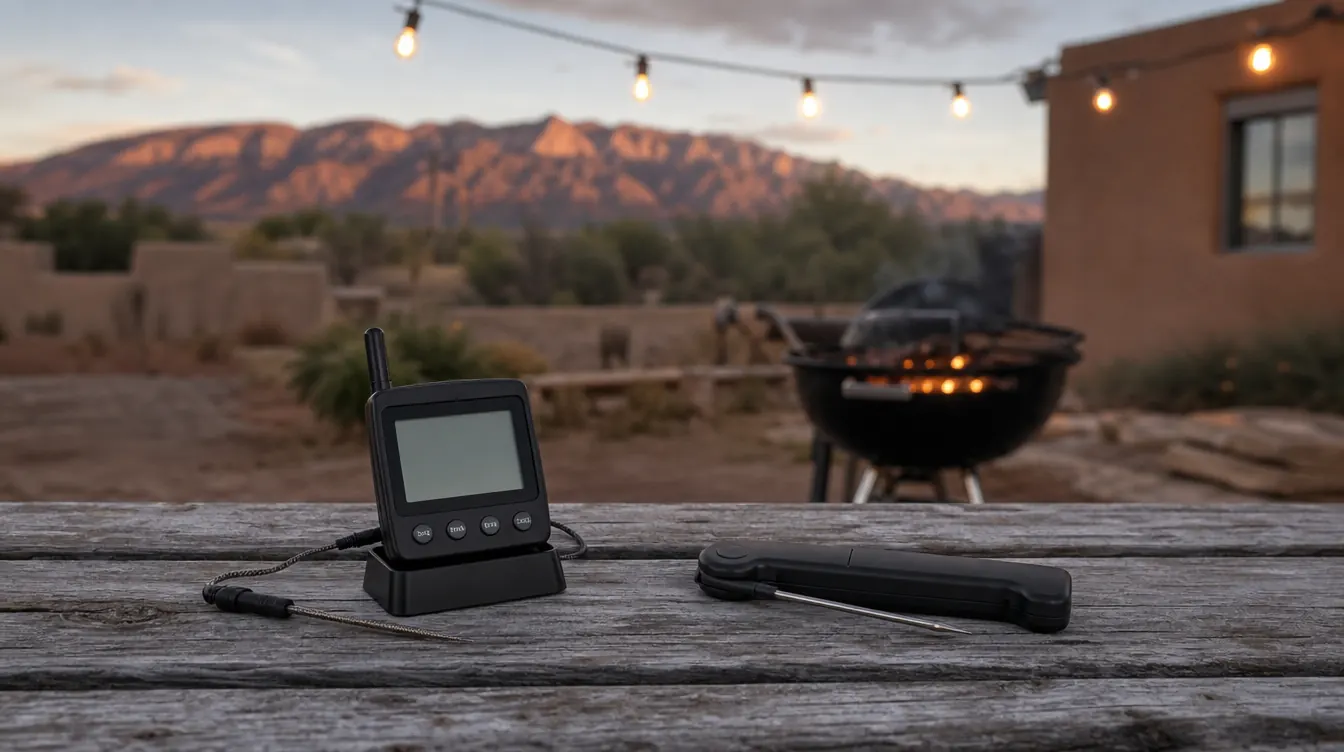
I get some version of this question every few months from a neighbor standing at my fence watching smoke roll off my kettle: do I need a fancy wireless thermometer, or is the little folding instant-read in my kitchen drawer good enough? The honest answer is that I own both, use both nearly every week, and they are not actually competing for the same job. The Inkbird IBT-4XS is the four-probe Bluetooth thermometer I've had strapped to nearly every brisket and pork shoulder I've smoked over the last year and a half, running at a mid-range price point as of this writing. A plain instant-read is the ten-second-answer tool I still reach for on a steak, a chicken thigh, or anything that's done cooking before I'd even finish pairing the Inkbird's app to my phone. Twelve summers of grilling at 5,000 feet in Albuquerque taught me that thin, dry air changes cook times in ways a recipe card never accounts for. Water boils around 202 degrees up here instead of 212, a brisket stall drags on longer than any chart predicts, and having the right thermometer for the right job matters more at this elevation than it might at sea level, where a little more margin for error is baked into every recipe.
So here is the short answer before the details. If you're running long, unattended cooks, brisket, pork shoulder, a full rack of ribs, where you want to track meat temperature and pit temperature for hours without lifting the lid, the Inkbird wins clearly. If you're grilling steaks, burgers, chicken breasts, or anything that finishes in under thirty minutes, a basic instant-read is faster, cheaper, and honestly more accurate in the moment, because it isn't sitting in direct heat for hours the way a leave-in probe is. Most serious backyard cooks I know end up owning both, and once you see the table below, it'll be pretty obvious why neither one makes the other obsolete. They're solving two different problems on two very different timelines, and trying to make one thermometer do both jobs usually means it does neither one especially well.
| Spec | Inkbird IBT-4XS Wireless | Handheld Instant-Read Thermometer |
|---|---|---|
| Read Speed | Continuous, updates every few seconds while the probe stays in the meat | 2 to 3 seconds per check, but the lid has to open and the probe has to be inserted each time |
| Unattended Monitoring | Yes, leave the probe in place and watch the app or base station from the kitchen | No, requires physically checking the meat every time you want a number |
| Number of Probes | 4 probes, tracks two meats plus ambient pit temperature at once | 1 probe, one reading at a time, one item at a time |
| Alarm Capability | High and low target alarms per probe, phone push alert and base station beep | None, you set your own timer or just remember to check |
| Battery Life | About 4 months on alkaline AAAs under heavy weekly use, longer on lithium | A single CR2032 coin cell that lasts a year or more under occasional use |
| Accuracy Over Time | Within about 1 degree fresh out of the box, drifted 2 to 4 degrees warm after several months of continuous heat exposure | Stays close to its factory calibration since it's only in the heat for a few seconds at a time, not hours |
| Best Use Case | Long low-and-slow cooks, brisket, pork shoulder, multi-item weekend smokes | Quick spot checks, seared steaks, weeknight chicken, verifying several items fast |
| Durability Over a Season | Probe cables have held up fine, but they see continuous heat and get looped over hot grates | Folding probe stores closed in a drawer, almost nothing to wear out, cheap to replace if lost |
Where the Inkbird Wins
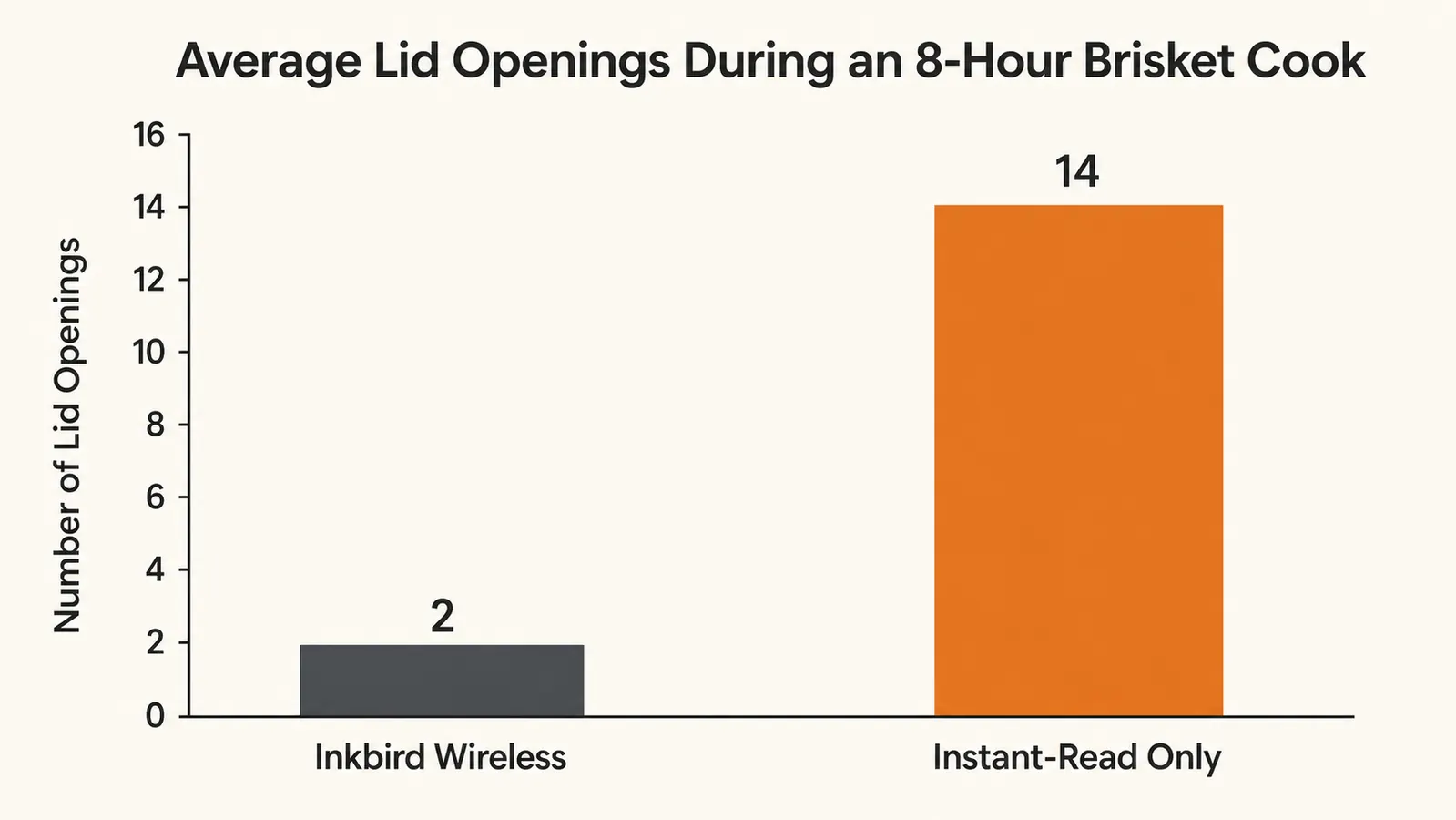
The Inkbird's whole reason for existing is unattended monitoring, and that's exactly where it earns its keep. On a seven or eight hour brisket cook, the difference between checking a probe on your phone from the kitchen table and walking outside to lift the lid isn't a small convenience, it's real heat management. Every time you open a kettle lid at 5,000 feet, you're losing heat you then have to rebuild in air that's already thinner and less forgiving than sea level, and that recovery time adds up over a long cook. I tracked this loosely across a handful of cooks last season: with the Inkbird running, I opened the lid maybe twice during a full brisket cook, once to add a small amount of fuel and once to wrap in butcher paper. Running the same length of cook with just an instant-read, back before I owned the Inkbird, I was lifting that lid something closer to fourteen times, mostly out of nerves, guessing whether the stall had actually broken or if the fire needed attention.
The four-probe setup matters just as much as the wireless part. On a weekend where I'm running two pork shoulders side by side, I can put a probe in each one plus a third clipped to the grate for ambient pit temperature, and watch all three numbers on one screen from wherever I happen to be. An instant-read simply cannot do that. You'd need three separate people walking back and forth with one thermometer, or you'd be guessing at two of the three numbers the whole time while you check the third. The alarm feature closes the loop on top of that. Set a high alarm at 203 for the brisket and a low alarm at 225 for the pit, and the Inkbird tells you the moment either one needs attention instead of you needing to remember to check every twenty minutes, which is exactly the kind of thing that slips your mind during a long Saturday cook with guests around.
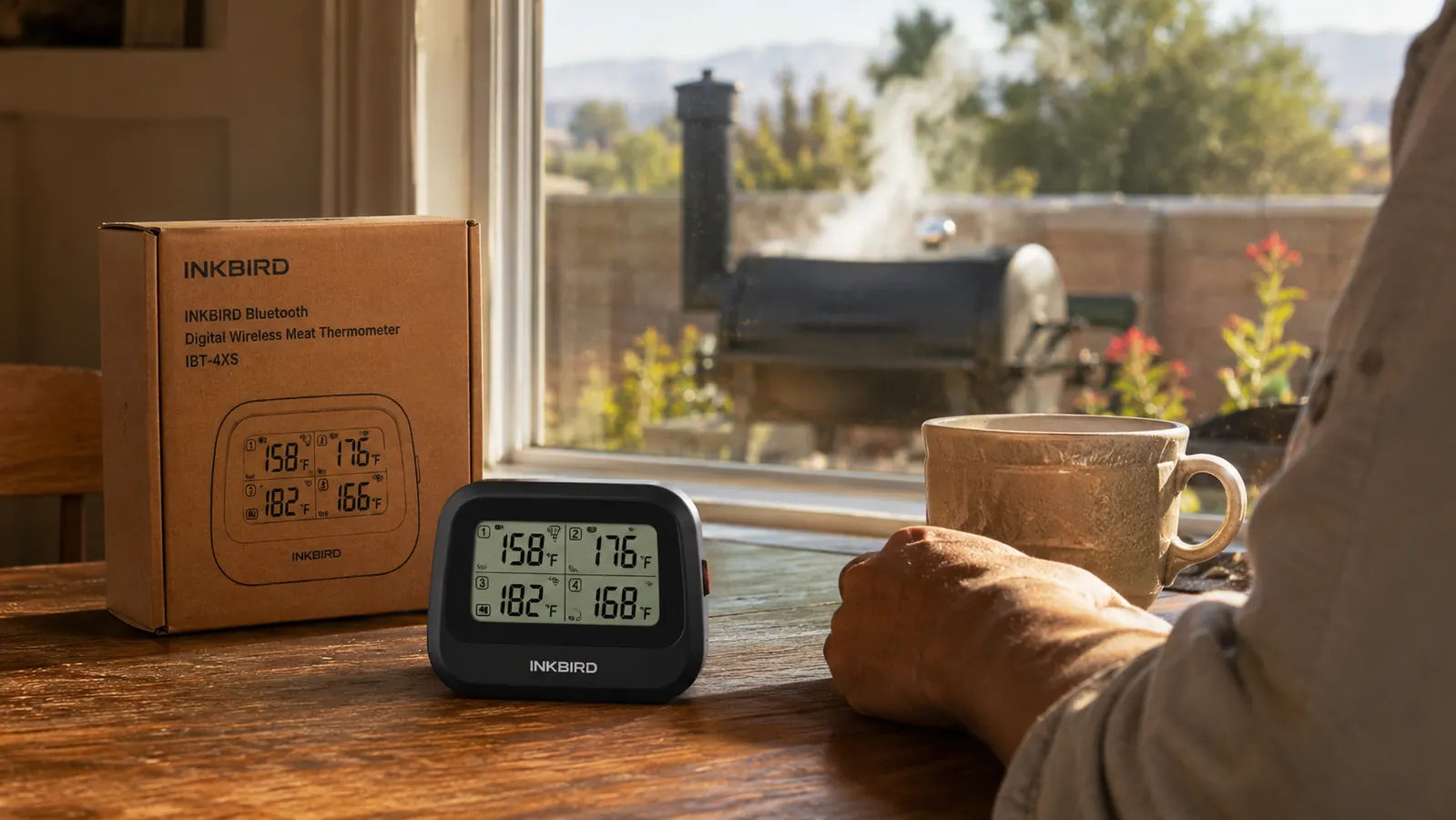
I ran a pork shoulder overnight last October, started it around 10pm on a cold, clear high-desert night, and set the Inkbird's low-pit alarm at 225. I woke up twice, checked the app on my phone from bed both times, saw the pit holding steady, and went back to sleep instead of pulling on boots and a jacket to walk out to the kettle in 38-degree air. That's the kind of thing that sounds small until you've actually done the alternative a dozen times, hauling yourself outside every couple of hours just to confirm nothing had gone wrong. An instant-read gives you no way to check anything without physically walking out to the grill first, which matters a lot less at noon than it does at 2am.
There's also a psychological piece to this that I didn't expect when I bought it. The app's graph view shows temperature climbing over time, and once you can see the stall as a flat line on a chart instead of just a single number that hasn't moved in an hour, it stops feeling like something's wrong with your fire. That confidence is worth something on its own, especially on a cook you're hosting family or friends around, because a calm cook is a better cook. That's simply not something a single-point instant-read reading can give you, no matter how accurate that one reading happens to be, and it's the biggest reason the Inkbird has stayed in near-constant rotation on anything longer than an hour or two.
Where an Instant-Read Wins
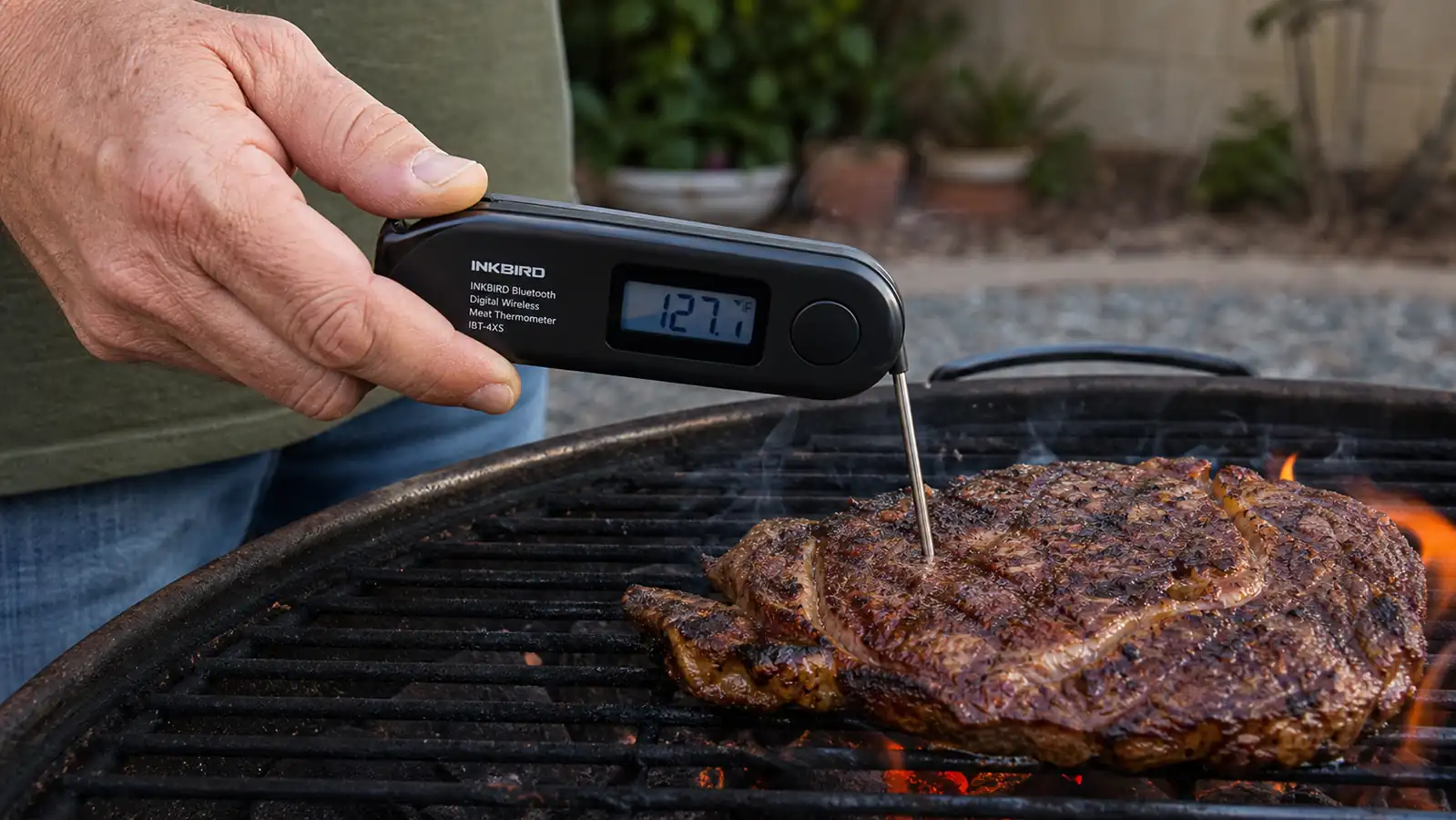
None of that means the Inkbird makes an instant-read pointless, and I want to be straight about where a simple handheld unit actually pulls ahead. Speed of a single check is the most obvious one. If I've got a ribeye on high heat over mesquite coals and I want to know if it's hit 130 for medium-rare, I don't want to dig out a base station, pair an app, and clip a probe on. I want to press a folding thermometer into the side of the steak for two or three seconds, get my number, and pull the meat off the grate before it overshoots. For anything that cooks in under half an hour, the setup time on a wireless probe is genuinely longer than the cook itself, and by the time you'd get it clipped in and paired, the steak's already past medium.
Accuracy in the moment is the other real advantage, and it surprised me the first time I really sat down and thought it through. A leave-in probe sits in direct heat for hours at a time, and that continuous exposure is exactly why the Inkbird's probes drifted 2 to 4 degrees warm on mine after several months of regular use. An instant-read is only in the heat for a couple of seconds per check, so it holds its factory calibration much longer, and it doesn't need the same periodic ice-bath sanity check I run on the Inkbird's probes every couple of months to keep them honest. If you're checking several different items during one cookout, a burger here, a chicken breast there, a quick temp on some grilled squash for whoever's watching their carbs, an instant-read is also just more practical. You're not tying up four channels on a base station for things that finish in ten minutes apiece.
It also covers ground the Inkbird flatly can't. On a Sunday last spring I fried a batch of green chile empanadas in oil pushing close to 375 degrees, and I used the same instant-read to confirm the oil temperature before dropping anything in. None of the Inkbird's four probes are rated for submersion in hot oil, and I wouldn't trust the silicone boot on a leave-in probe anywhere near a fryer anyway. A folding instant-read handles oil, dough proofing, a quick check on reheated leftovers, and a dozen other kitchen jobs that have nothing to do with a smoker, which is a versatility the Inkbird was never built to have.
Cost and simplicity matter too, and I don't think that gets said enough in reviews built around the fancier tool. A basic instant-read has almost nothing to fail. No Bluetooth range to worry about, no app that drops connection in the background, no batteries running down mid-cook because you forgot to check them before company showed up. Mine has lived in a kitchen drawer for years, gets pulled out constantly, and I've never once thought about its battery until I actually needed to replace the little coin cell inside, which happens maybe once every year or two at most. That kind of low-maintenance reliability is worth real money to anyone who isn't running long overnight smokes on a regular basis and just wants a fast, honest number without fussing with an app that occasionally needs ten or fifteen seconds to reconnect.
Running Long Cooks Without Anything Tracking Them?
The Inkbird IBT-4XS is the four-probe wireless thermometer that's replaced most of the lid-lifting and guesswork on my longer smokes. If brisket, pork shoulder, or a full rack of ribs is on your weekend calendar, this is the tool that watches it while you don't have to.
Amazon Check Today's Price on Amazon →Who Should Buy Which
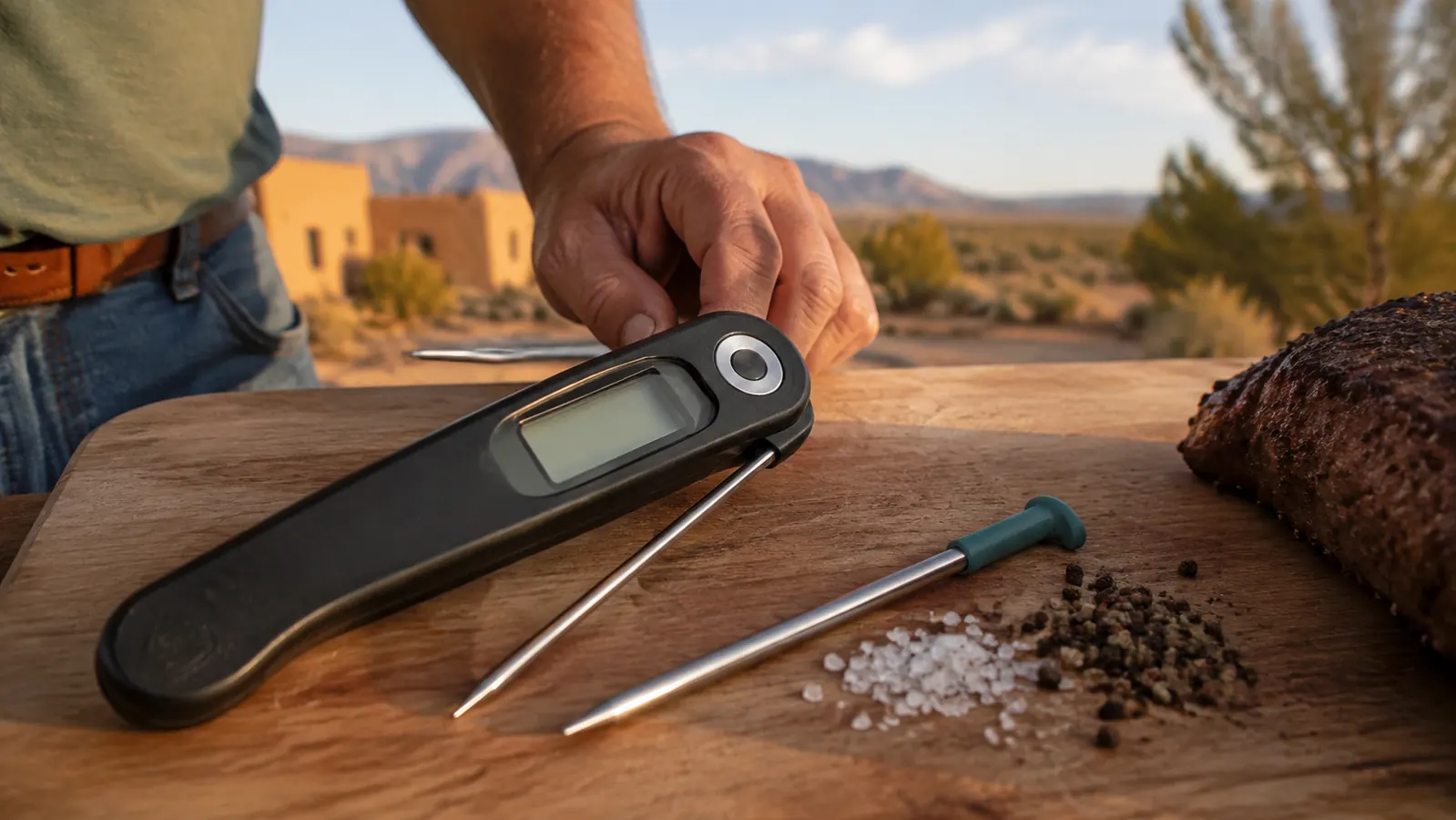
If most of your cooking is long and low, brisket, pork shoulder, ribs, whole chickens on indirect heat, and you're tired of losing heat every time you lift the lid to check on things, buy the Inkbird first. It's the tool that changes how you actually manage a fire over several hours, not just a nicer way to take a temperature reading. It's also worth it for anyone who wants to run two smokes at once, since tracking two meats and a pit temperature from one base station is the exact scenario a single-probe instant-read can't touch. If you're mostly grilling steaks, burgers, chicken pieces, and quick weeknight dinners where everything finishes in under half an hour, an instant-read will serve you better and cost a lot less to own. It's faster for the exact job you're doing most nights, and it won't sit unused in a drawer between cooks the way a four-probe wireless unit will if you're not running long, unattended smokes on any regular basis.
Budget plays into this too, and it's worth naming plainly. A decent instant-read can be had for a fraction of what the Inkbird runs, so if you're just starting out and money's tight, an instant-read gets you accurate readings on almost everything you'll grill in your first year without the bigger outlay. The Inkbird earns its higher price once you're actually running cooks long enough that unattended monitoring pays for itself in saved time and fewer ruined briskets, not before. I'd rather see someone buy the cheap tool first and grow into the wireless setup once they know they need it, than spend on four probes they'll rarely use all at once.
If you're serious about backyard cooking the way I am, honestly, don't think of this as an either-or decision. I use my instant-read several times a week for quick checks on smaller cuts, and I use the Inkbird for anything that's going to run more than an hour unattended. They solve two different problems, and owning just one leaves a real gap on the days you need the other. If I had to pick a single starting point for someone who mostly grills quick dinners but is starting to smoke bigger cuts on weekends, I'd say start with the instant-read you probably already own, and add the Inkbird the first time you find yourself hovering over a smoker for six hours wishing you could just glance at your phone from the couch instead.
Stop Guessing on the Cooks That Actually Take Hours
For quick grilling, an instant-read still earns its spot in the drawer. For anything that runs long and unattended, the Inkbird IBT-4XS is the one I actually trust. Check today's price and see if it's the missing piece in your setup.
Amazon Check Today's Price on Amazon →